Explain a revenue drop
Revenue fell 12% last week. Compare it with the previous four weeks by region and channel, and show which segment caused most of the drop. Where should I look first?
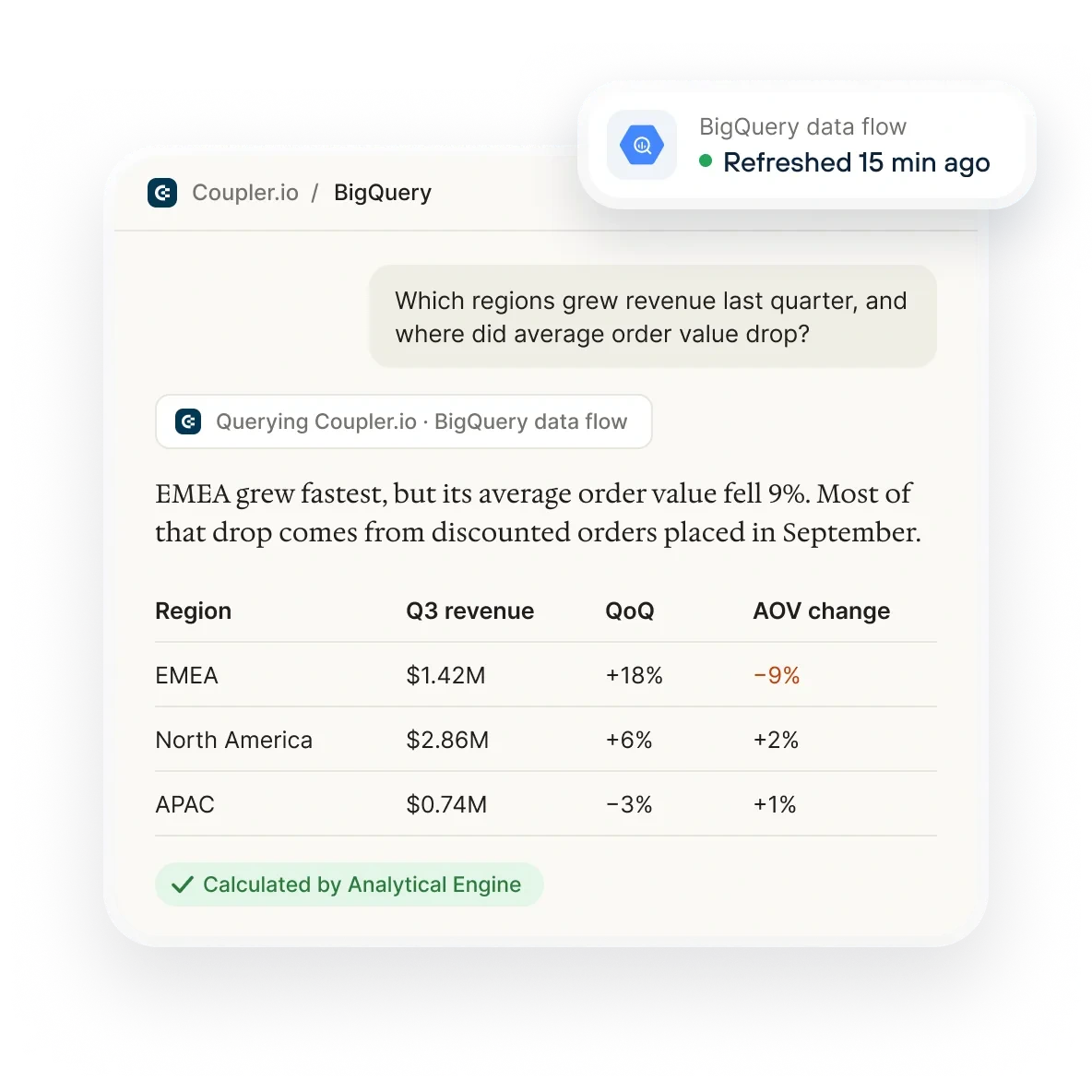
AI agents connected through Coupler.io don’t query your BigQuery tables directly. Coupler.io runs each calculation on your synced query results and hands the model the computed answer.
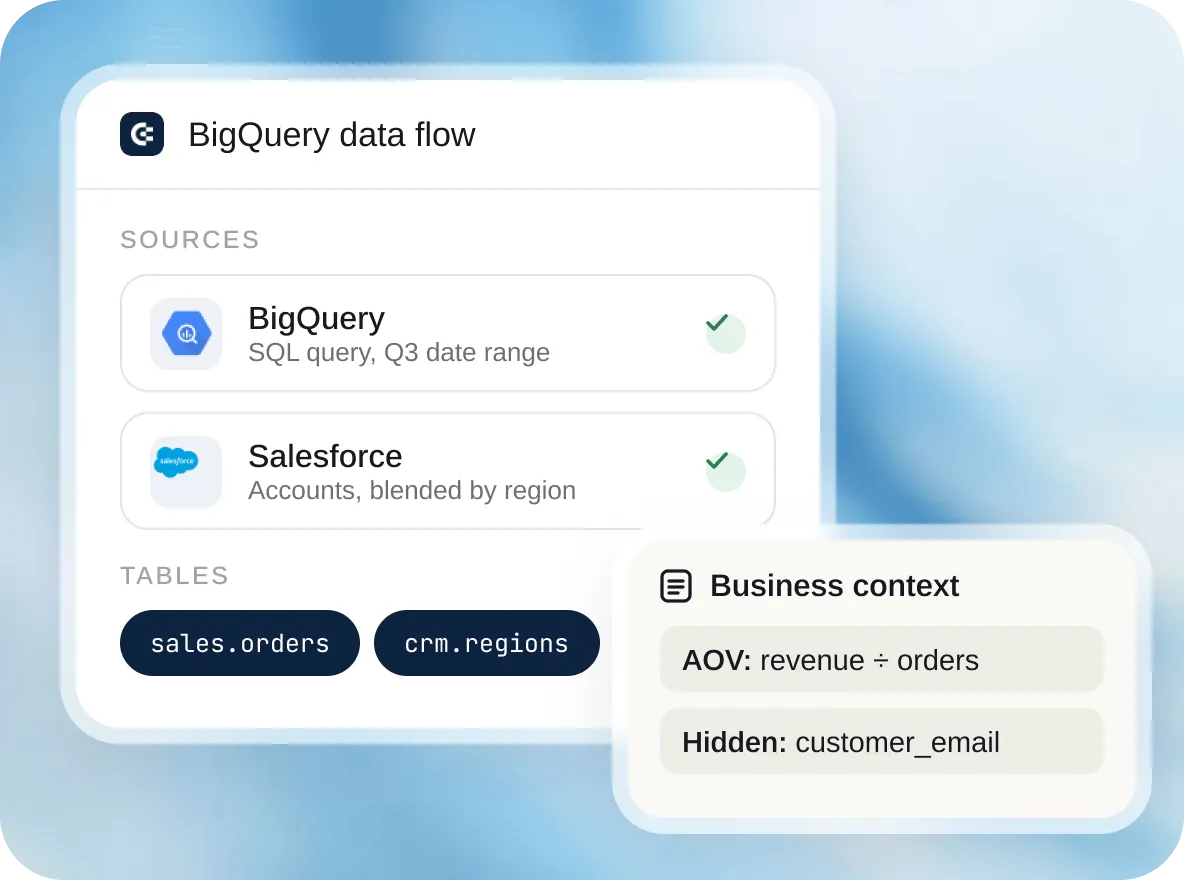
Decide exactly which warehouse data the AI can read
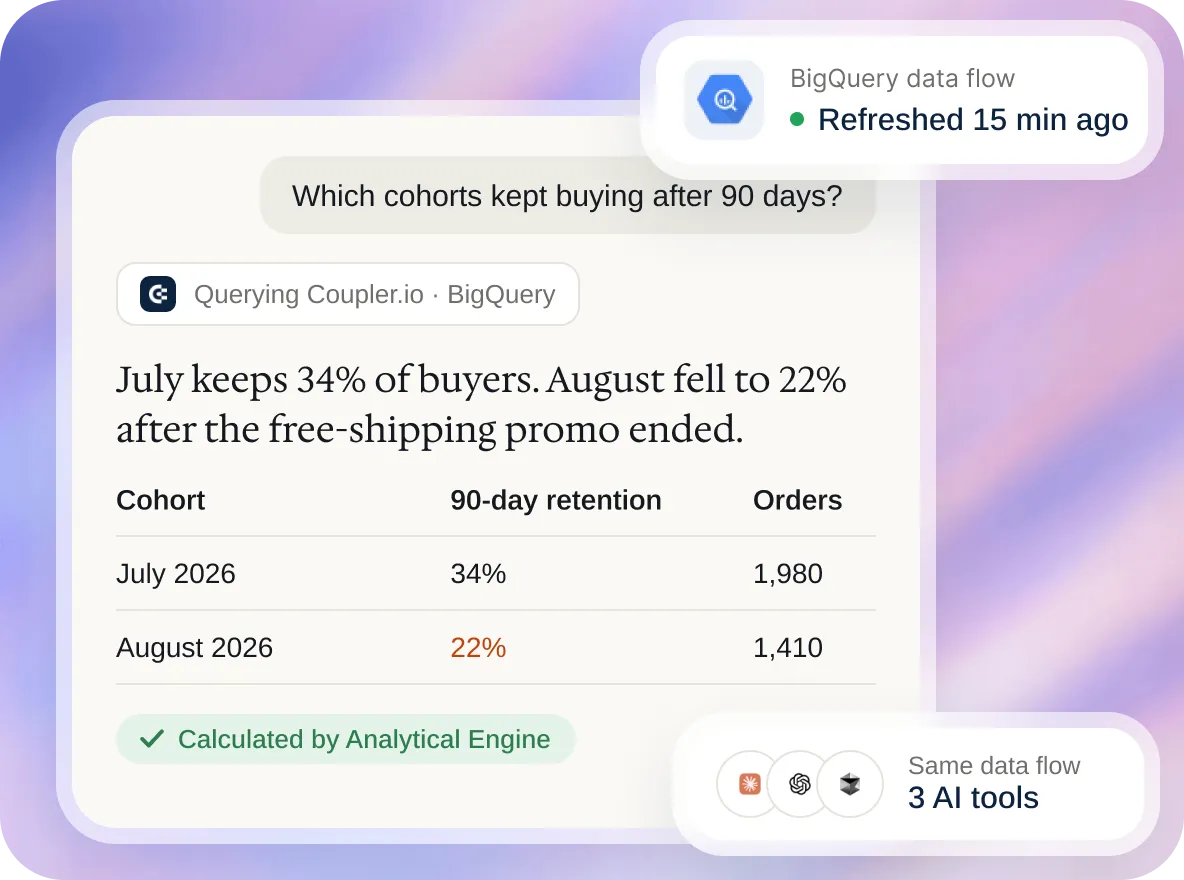
Work in the AI tool your team already has open
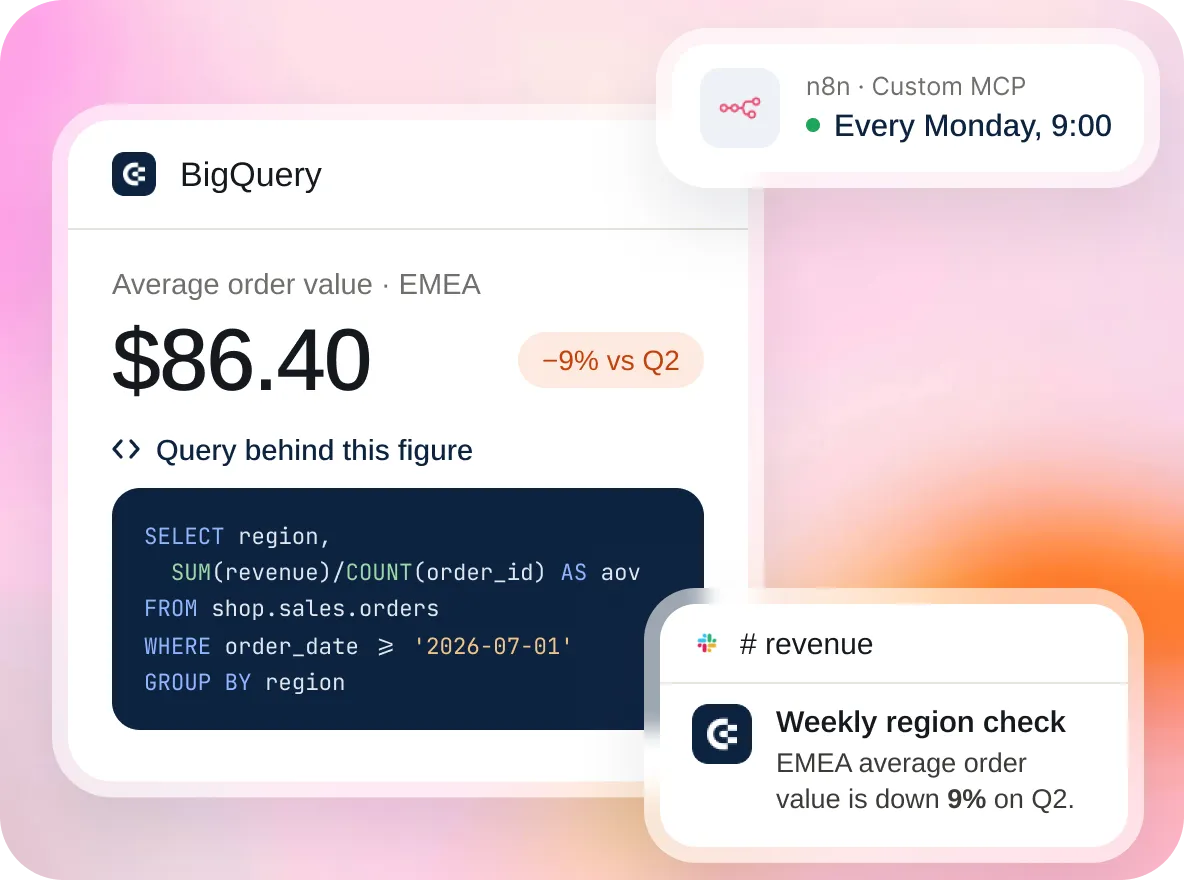
Get each answer to the people who make the call



I'm not getting AI's best guess. Coupler.io does that actual math. Claude just helps me ask the right question and understand the results conversationally
Copy a prompt into your AI tool and change the table names, dates or thresholds to match your warehouse.
Revenue fell 12% last week. Compare it with the previous four weeks by region and channel, and show which segment caused most of the drop. Where should I look first?
Group customers by signup month for the last 12 months and show 90-day retention for each cohort. Which cohorts fell below 40%, and what do they have in common?
Join ad spend by channel with closed revenue for last quarter. Which channels returned less than $2 for every $1 spent, and which budget should we cut first?
List accounts whose weekly active users dropped more than 30% over the last 60 days, with plan and renewal date. Which renewals in the next 90 days need a call?
Show the share of active accounts using each feature this month versus three months ago, by plan. Which features lost adoption, and where should the product team dig in?
Check the orders data for the last 30 days for duplicate order IDs and days with less than half the usual row count. What should I fix before the month-end report?
Based on daily revenue so far this month and the same period last year, estimate where we'll close. How far are we from the $500,000 target?
List the top 20 customers by revenue over the last 12 months with order frequency and last order date. Who hasn't ordered in 60 days?
Write a one-page summary of last month for the leadership team: revenue, new customers, churn and the two biggest gaps against plan. Add one risk to watch next month.
Skills are step-by-step procedures your AI loads for recurring analysis. Each run follows the same steps, and this week's numbers stay comparable with last week's.

Turns raw analysis into a clean, decision-ready report. Runs validation on figures and claims before delivery so you can share it with stakeholders without a second pass. Outputs markdown, summarize-ready text, or formatted tables.
Builds a live dashboard over your Coupler.io data that you can reopen every morning and that refreshes on a schedule.
Reads your dataset and documents its structure so analytics skills know exactly what data they're working with. Run this first for more accurate results. Think of it as giving the AI domain expertise about your specific data.
Turns a rough request into a precise system prompt so your AI returns the analysis you actually need. Handles prompt validation and formatting automatically.


Analyzes paid media performance across Google Ads, Meta, LinkedIn, and TikTok. Surfaces ROAS, CPA, budget pacing issues, and attribution gaps. Handles each specific task so your AI doesn't hallucinate metrics from thin air.


Analyzes pipeline and CRM data from Salesforce, HubSpot, Pipedrive, and more. Covers win rate, deal velocity, stage conversion, and rep performance. Works as a standalone skill or combined with marketing-analytics for full-funnel orchestration.
Building agents with Google's Agent Development Kit (ADK), or workflows in n8n, Make or Zapier? The Custom MCP destination gives any MCP client a remote endpoint for your BigQuery data.
Add your service account key, write the SQL query, and set a refresh schedule.
Generate a token and copy the server URL.
Claude Desktop, Claude Code, Cursor, and ADK agents that accept a remote server can query the data right away.
{
  "mcpServers": {
    "coupler": {
      "url": "https://mcp.coupler.io/mcp/10146",
      "headers": {
        "Authorization": "Bearer YOUR_TOKEN"
      }
    }
  }
}
Google offers a remote MCP server at bigquery.googleapis.com/mcp and the open-source MCP Toolbox for Databases. Both give AI agents live access to your BigQuery datasets and suit developers in Gemini CLI or ADK who want the model to write its own SQL. Coupler.io is built for analysis: it hosts the connection and calculates answers on the data you scope.

Connect Google BigQuery to your AI tool with Coupler.io. Check last week’s revenue or compare cohorts on synced data, with no server to run or maintain.
Model Context Protocol (MCP) is an open standard that lets large language models read data from other systems. A BigQuery MCP server connects your data warehouse to AI agents and assistants, and you ask about your tables in plain language from Anthropic's Claude, ChatGPT or another MCP client. Coupler.io runs it as a hosted Google BigQuery MCP server connector. Add your BigQuery project, choose the data and your AI tool, then start asking.
Google's remote MCP server and the open-source MCP Toolbox for Databases give AI agents live access to the BigQuery datasets in your Google Cloud project. They suit developers building on Google Cloud with ADK or Gemini CLI, where the model writes SQL and each query runs as a BigQuery job. Coupler.io's BigQuery MCP connector is made for analysis. You scope the data once with one service account, skip per-client OAuth setup and get answers calculated in SQL on data you can combine with 400+ sources.
The model doesn't do the math. Coupler.io's Analytical Engine runs SQL on your synced BigQuery data and passes the calculated result to the LLM to explain. You can open the query behind any figure. Saved definitions, like what counts as an active customer or net revenue, keep explanations in line with your team's reporting.
The connector reads query results and doesn't write anything back to BigQuery. Answers reflect your last sync, and the AI sees only the columns your SQL query returns. Each refresh runs your query in your BigQuery project, which bills by bytes scanned, and the SQL field doesn't accept dynamic parameters. Some AI tools also cap how much data they can take in at once. A focused query or an aggregated view works best.
No. Your AI tool never gets your service account key or direct access to your BigQuery project. When you ask a question, the Analytical Engine runs the query, and the LLM receives only the dataset schema, column types, a small data sample and the calculated result. The full dataset stays in Coupler.io, which is SOC 2 Type II certified and compliant with GDPR, HIPAA and DORA. Data is encrypted with AES-256 at rest and TLS in transit.