Weekly trading check
How did the store do last week versus the week before? Break revenue down into number of orders, average order value and refunds, and tell me which one moved most.
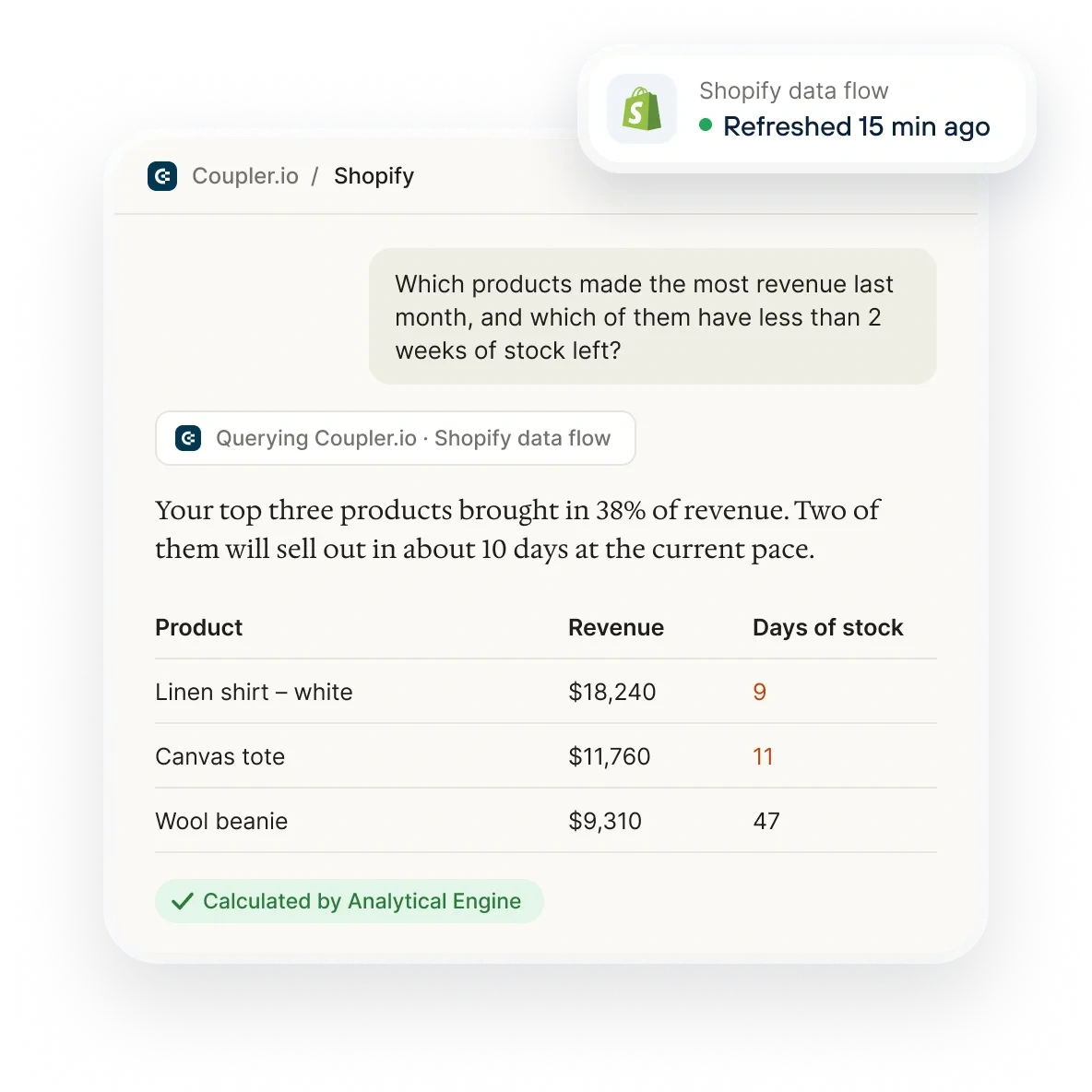
Your AI tool never queries your store directly.
It asks Coupler.io, which runs the calculation on your synced Shopify data and sends back only validated results.
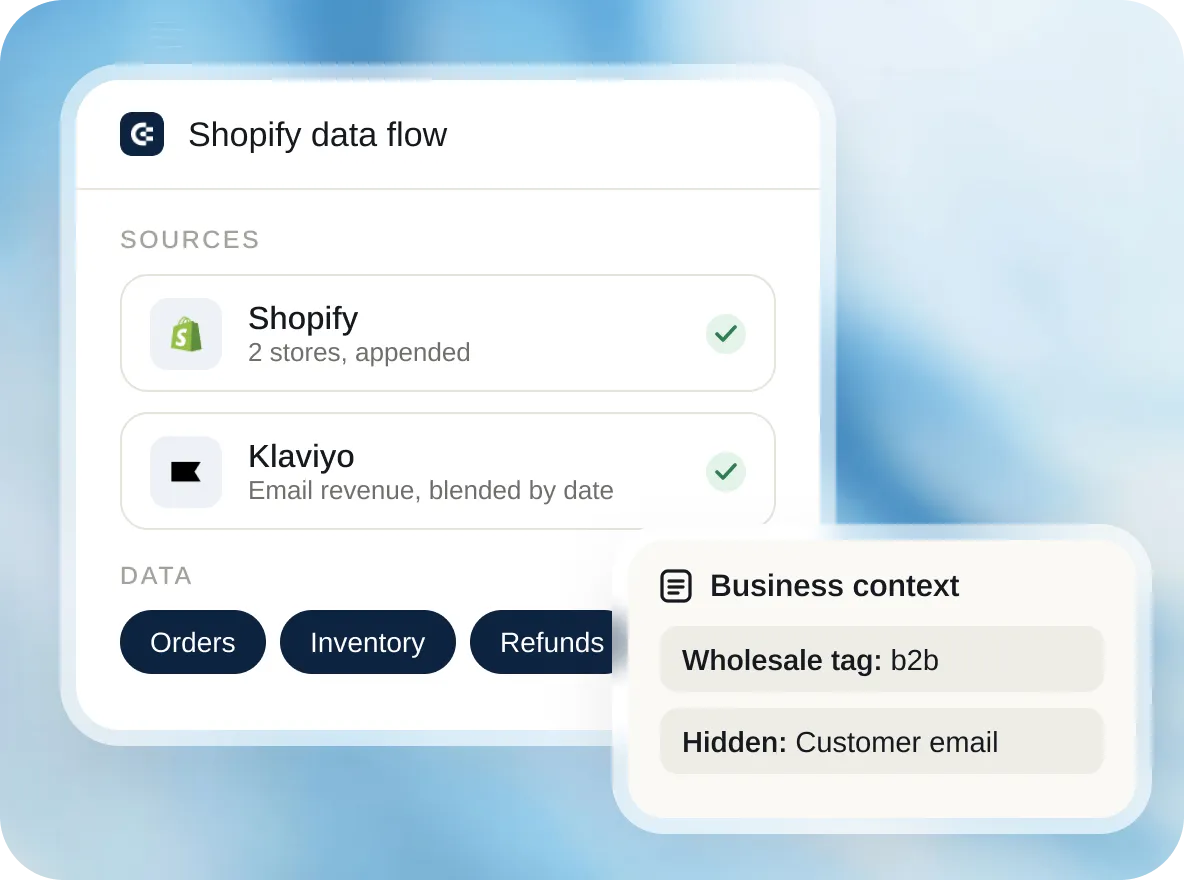
Prepare your store data for AI, so answers reflect your catalog, prices and customers
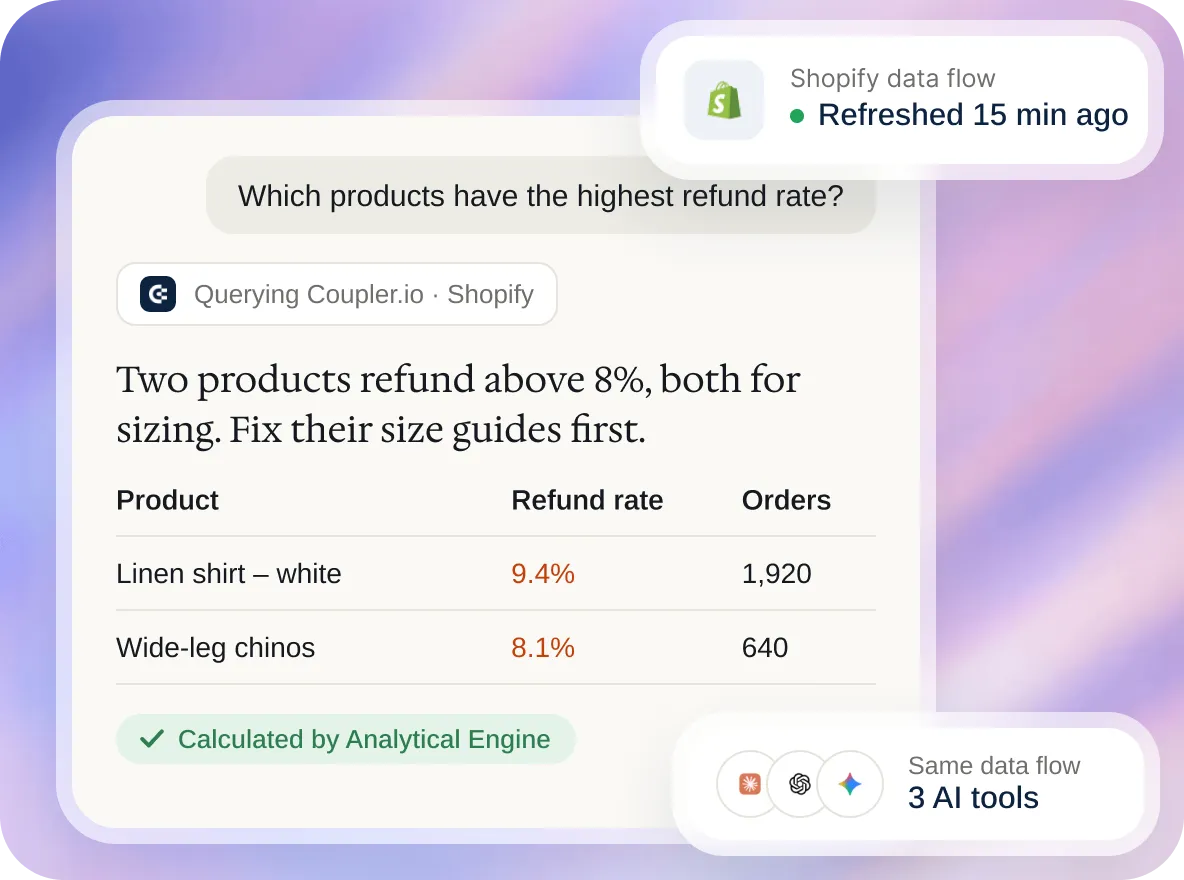
Query the same prepared dataset from any AI tool on your team
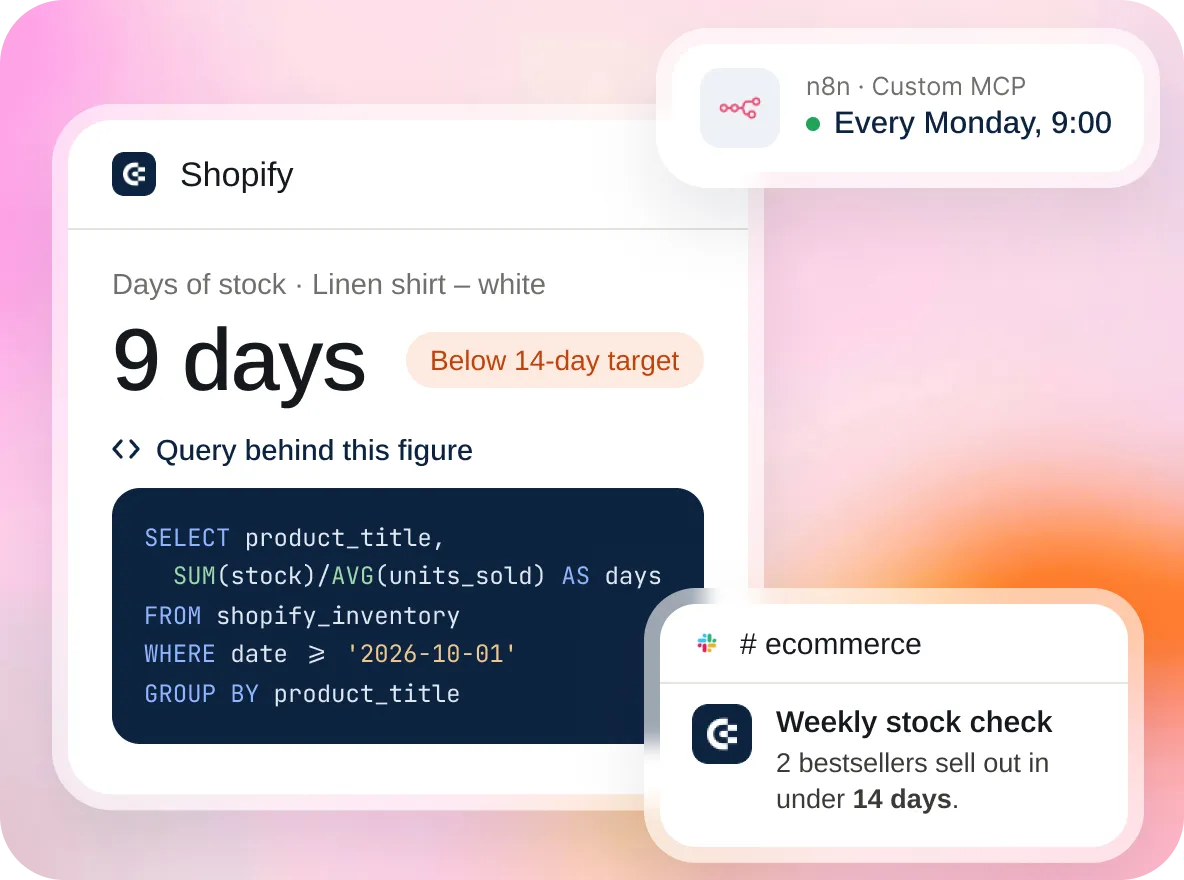
Turn answers into reorders, promotions and reports without exporting CSVs from the Shopify admin


Copy any of these into your AI tool. Change the periods, thresholds, or product names to fit your store.
How did the store do last week versus the week before? Break revenue down into number of orders, average order value and refunds, and tell me which one moved most.
Show the top 15 products by revenue for the last 30 days with units sold and refund rate. Which ones grew most compared with the previous 30 days?
For each product with more than 100 units sold this quarter, list variants by product ID and variant ID that sold less than 5% of the total. Which variants should we drop?
Based on the last 28 days of sales, which SKUs will run out within 14 days? Suggest reorder quantities for 60 days of cover.
What share of customers who first ordered between January and March placed a second order within 90 days? How does that compare with last year?
Compare orders that used a discount code in the last 60 days with full-price orders on AOV, refund rate and repeat purchase rate.
Which products had a refund rate above 8% in the last 90 days? Group refunds by reason note and show revenue lost per product.
What was the average time from order to fulfillment by shipping method last month? Which orders took longer than 5 days?
Write a one-page report on last month for the founders: revenue, orders, AOV, new vs returning customers, top five products and two stock risks.
Skills turn routine store analysis into repeatable steps.
Your AI picks the right one for the question and runs it the same way every time, from sales checks to reorder plans.

Shows how your Shopify store did and whether a change in revenue came from orders, order value or refunds.
Shows which products and variants in your store sell, which make money, and which to reorder, drop or mark down.
Shows which campaigns, first products and first-order discounts bring Shopify customers who come back and buy again.
Shows what in your Shopify store will sell out, when you need to reorder, and how much cash is sitting in dead stock.
If you run your own ops agent or an n8n flow that posts daily sales to Slack, give it store data through a Custom MCP endpoint.
Pick the entity, such as orders with line items, and a sync schedule.
Coupler.io gives you a token and a server URL. Copy both.
Add them to Claude Desktop through claude_desktop_config.json, or to Claude Code, Cursor, VS Code or any other AI client with remote MCP support, and your AI agents can read the store.
{
  "mcpServers": {
    "coupler": {
      "url": "https://mcp.coupler.io/mcp/10146",
      "headers": {
        "Authorization": "Bearer YOUR_TOKEN"
      }
    }
  }
}
Shopify ships its own MCP tools, but they are made for developers and shoppers. The Dev MCP server in the Shopify AI Toolkit helps developers search docs and write GraphQL queries against the GraphQL API. Storefront MCP and the Universal Commerce Protocol (UCP) let AI agents browse catalogs and build carts on your Shopify storefront, and Customer Accounts MCP handles a buyer's own orders. Coupler.io is the option for merchants who want to analyze their store.

Bring Shopify into your AI assistant with Coupler.io and get trading checks, reorder lists and retention numbers in a few minutes. No apps to build, webhooks to wire up, or scripts to maintain.
MCP, the Model Context Protocol, lets AI assistants call outside tools and data. For merchants, a Shopify MCP connection means you can ask ChatGPT, Claude or Gemini about orders, products and customers instead of digging through admin reports. Coupler.io's Shopify MCP server connector is hosted, so connecting a store takes a sign-in rather than a developer. You don't need the Shopify AI Toolkit or any code.
Shopify's servers solve other problems. Dev MCP helps developers build apps against the Shopify Admin GraphQL API. Storefront MCP, UCP and Customer Accounts MCP power agentic commerce, where AI agents shop or track orders on a buyer's behalf. None of them is a Shopify MCP server for sales reporting. Coupler.io's Shopify MCP connector is for analysis: it syncs your sales data, calculates results in SQL and can mix in ad spend or accounting data.
The model never sums your orders itself. SQL in Coupler’s Analytical Engine handles the totals on your synced store data and verifies them, and only then does the AI describe what they mean. Each number has its query attached, and the rules you set, like excluding test orders, shape every calculation.
It's read-only, so creating discount codes, editing products or refunding orders still happens in your Shopify admin. Shopify's own analytics, such as sessions and online store conversion rate, aren't part of the export, so add GA4 if you need traffic. Each data flow covers one store, metafields aren't included and test orders are kept unless you filter them out.
Only what you choose to share, and only in small pieces. Coupler.io runs each query itself and shares just the structure of the table, a handful of example rows and the final answer with the model, never the full table. You can hide fields like emails or addresses before any AI tool connects. The platform has passed a SOC 2 Type II audit, meets GDPR, HIPAA and DORA rules, and encrypts stored data with AES-256 and data in motion with TLS.