Find channels nobody uses
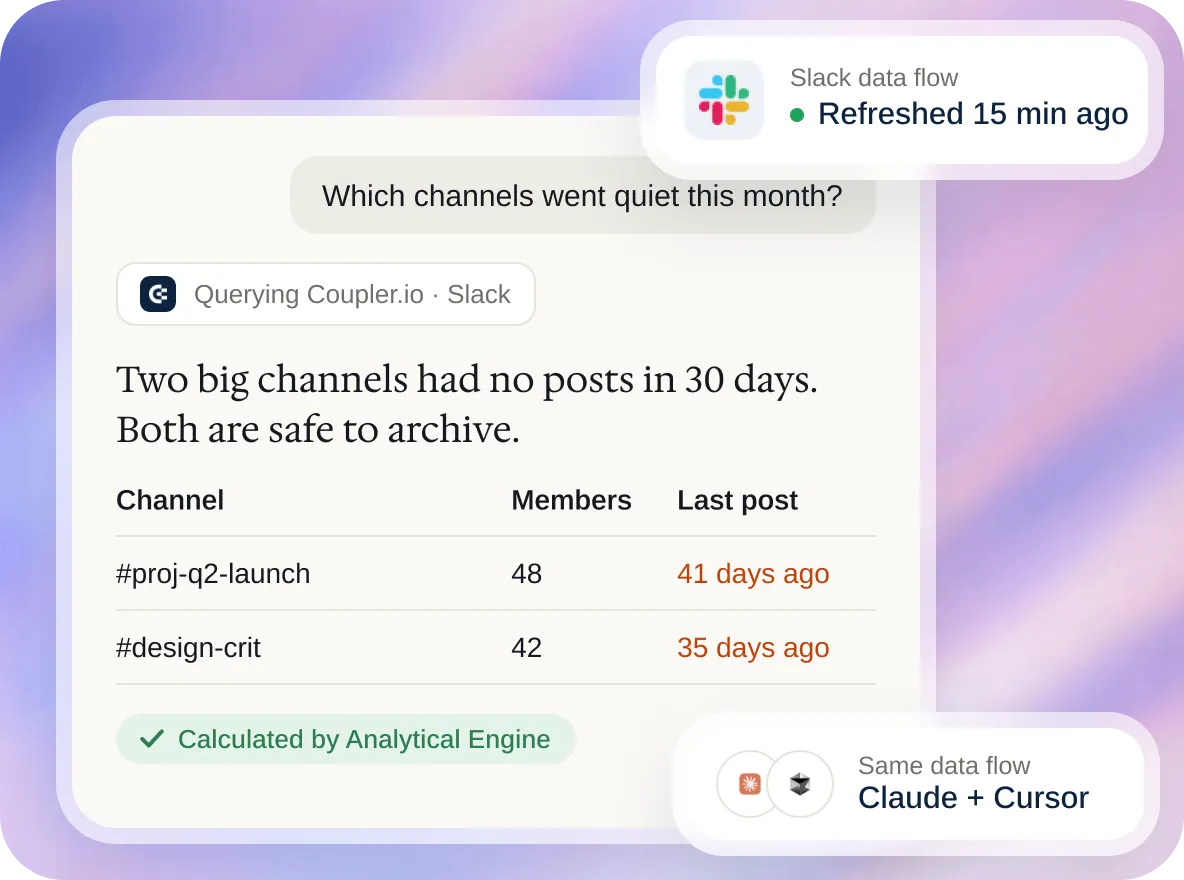
List public channels with fewer than 5 messages in the last 60 days, with member count and creation date. Which ones can we archive?
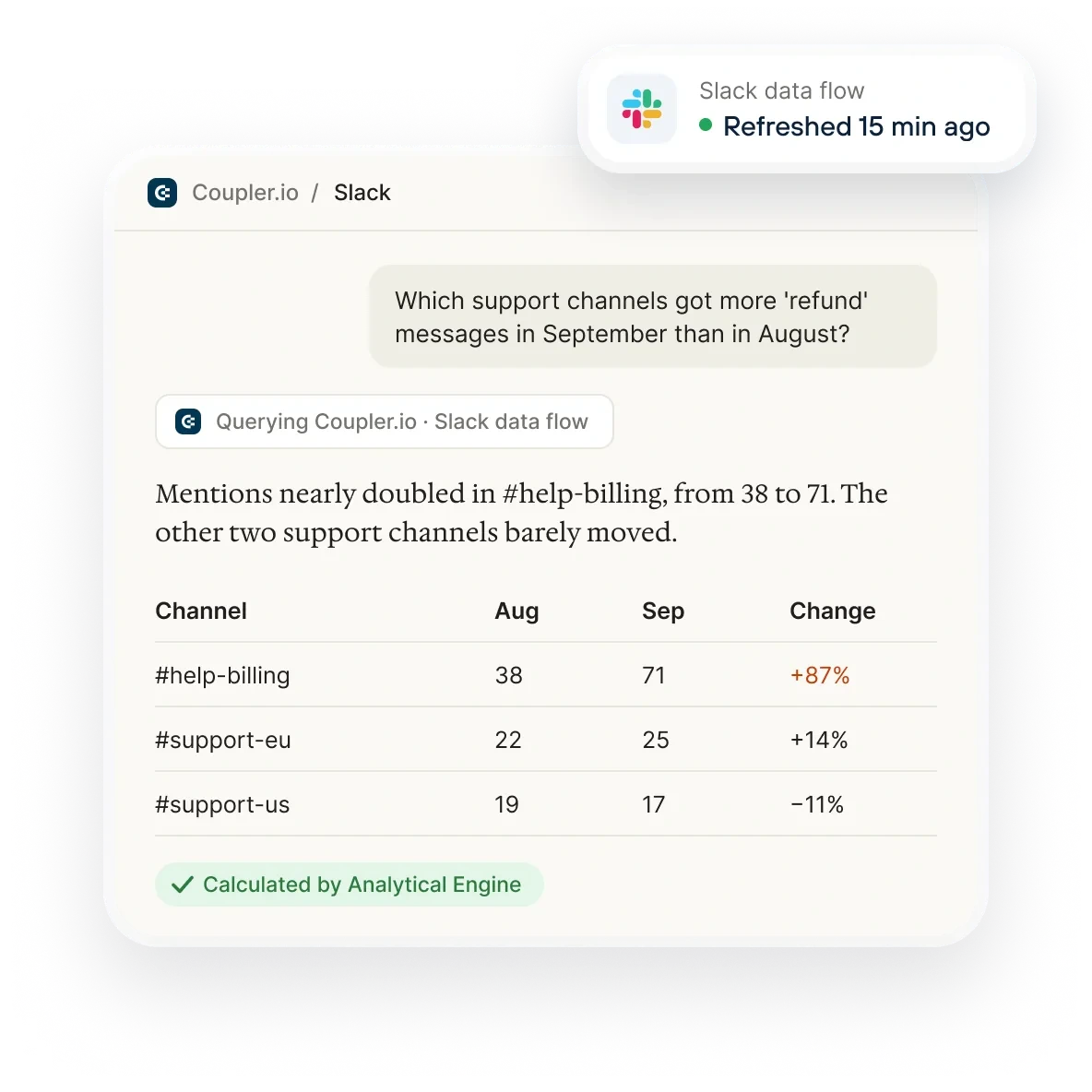
Your AI tool never calls the Slack API directly. It asks Coupler.io, which runs the math on your synced Slack data and hands back the calculated result.
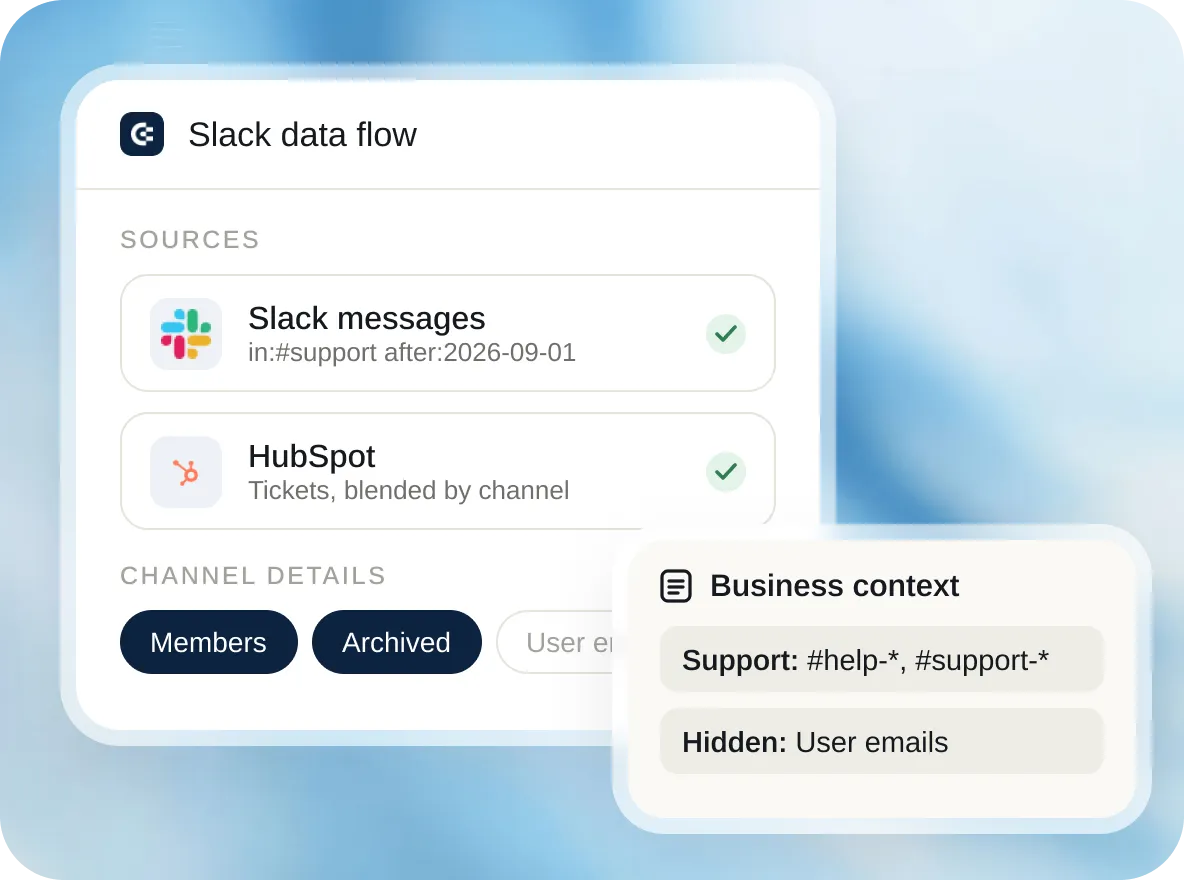
Choose the slice of Slack your AI should work with
Ask from the AI tool your team already opens every morning
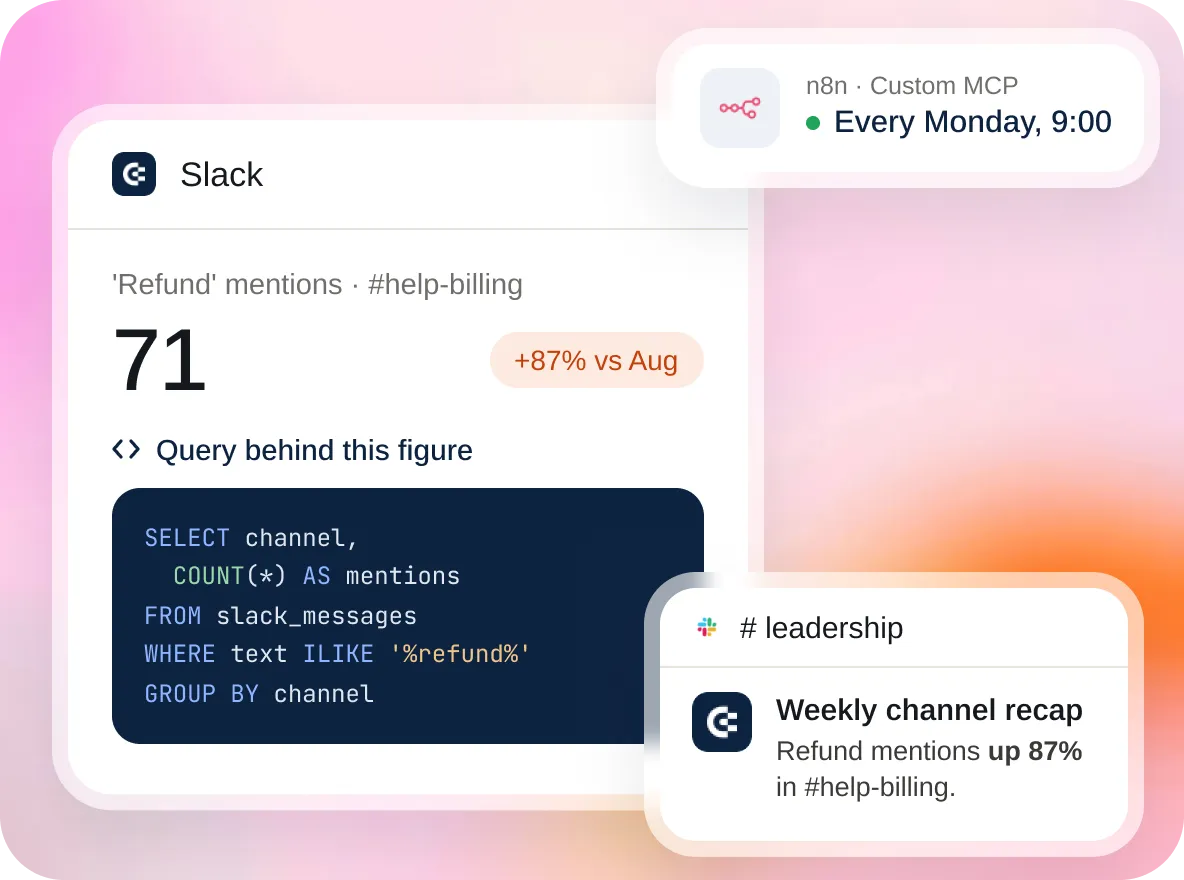
Take the answer to the people who need it



I'm not getting AI's best guess. Coupler.io does that actual math. Claude just helps me ask the right question and understand the results conversationally
Pick a prompt, paste it into your AI tool, and swap in your own channels and dates.
List public channels with fewer than 5 messages in the last 60 days, with member count and creation date. Which ones can we archive?
Count messages mentioning 'refund' per week in #help-billing and #support over the last 12 weeks. Is it rising, and when did it start?
How many messages mentioned 'outage' or 'incident' in each channel in September? Compare with August and tell me which team felt it most.
Rank the top 10 people by messages posted in #support in the last 30 days. Is anyone posting more than 30% of the channel alone?
Show messages in #customer-feedback from the last 14 days with 5 or more replies, sorted by reactions. Which ones should product read first?
Group active members of our Slack workspace by timezone and show the share in each. Which two-hour window suits most of the team?
List every admin account and every bot, with title and status. Flag deactivated users still in the export. Do we have more admins than we need?
Compare weekly messages mentioning 'bug' in #eng-support with Jira issues created per week last quarter. Do Slack spikes show up as tickets?
Summarize last week in #product with the message count and the five most-reacted posts. Keep it under 150 words for leadership.
Skills are ready-made procedures your AI loads for recurring work. This week's channel recap checks the same things as last week's.

Turns raw analysis into a clean, decision-ready report. Runs validation on figures and claims before delivery so you can share it with stakeholders without a second pass. Outputs markdown, summarize-ready text, or formatted tables.
Reads your dataset and documents its structure so analytics skills know exactly what data they're working with. Run this first for more accurate results. Think of it as giving the AI domain expertise about your specific data.
Builds a live dashboard over your Coupler.io data that you can reopen every morning and that refreshes on a schedule.
Building your own AI agents or automations in n8n, Make, or Zapier? The Custom MCP destination turns your Slack data flow into an endpoint any MCP client can query.
Add the user token from your Slack app, pick the data you need, and set a refresh schedule.
Generate a token and copy the server URL.
Use your Claude Desktop configuration, Claude Code, Cursor, VS Code, or any MCP client that accepts a remote server.
{
  "mcpServers": {
    "coupler": {
      "url": "https://mcp.coupler.io/mcp/10146",
      "headers": {
        "Authorization": "Bearer YOUR_TOKEN"
      }
    }
  }
}
Slack runs its own Slack MCP server at mcp.slack.com, generally available since February 2026. It gives AI agents live access to your Slack workspace and can post on your behalf. Coupler.io is built for the questions that need counting: it keeps a synced copy of your Slack data and calculates each answer in SQL. Here's how the two compare.

Connect Slack to your AI tool with Coupler.io. Find the channels nobody reads and track the complaints that keep coming back, with no code or servers to run.
Model Context Protocol (MCP) is an open standard that lets AI tools read data from other apps. Anthropic introduced it, and OpenAI and many others support it now. A Model Context Protocol (MCP) server for Slack connects your workspace to AI agents and assistants, and you ask about channel activity in plain language. Coupler.io runs it as a hosted Slack MCP server connector. Connect your Slack workspace once, then ask from the AI tool you already use.
Slack's MCP server is made for live work inside Slack: AI agents search messages and send messages for you, within each user's permissions. Coupler.io's Slack MCP connector is made for analysis. It keeps a synced copy of the Slack data you choose and counts it in SQL. You can also blend it with Jira, HubSpot or any of 400+ other sources, which Slack's server can't reach.
The AI doesn't do the counting. Coupler.io's Analytical Engine runs SQL on your synced Slack data and hands the calculated result to the model to explain. You can open the query behind any figure, which gives you an audit trail for numbers that end up in a report. Saved definitions, like which channels count as support, keep the explanations in line with how your team works.
The connector reads from Slack and never writes back, and answers reflect your last sync. Messages come from Slack search, which ranks by relevance and caps very large result sets, and narrow queries by channel and date work best. Attachments arrive as metadata only. Private channels appear only if the token owner is a member. Messages also need user tokens, since a Slack bot token can't run search.
No. Your AI tool never gets your Slack token or direct access to your workspace. When you ask a question, the Analytical Engine runs the query, and the LLM receives only the dataset schema, column types, a small data sample, and the calculated result. The full dataset stays with Coupler.io's Slack connector, and you can hide fields like user emails entirely. Coupler.io is SOC 2 Type II certified and compliant with GDPR, HIPAA, and DORA, with AES-256 encryption at rest and TLS in transit.